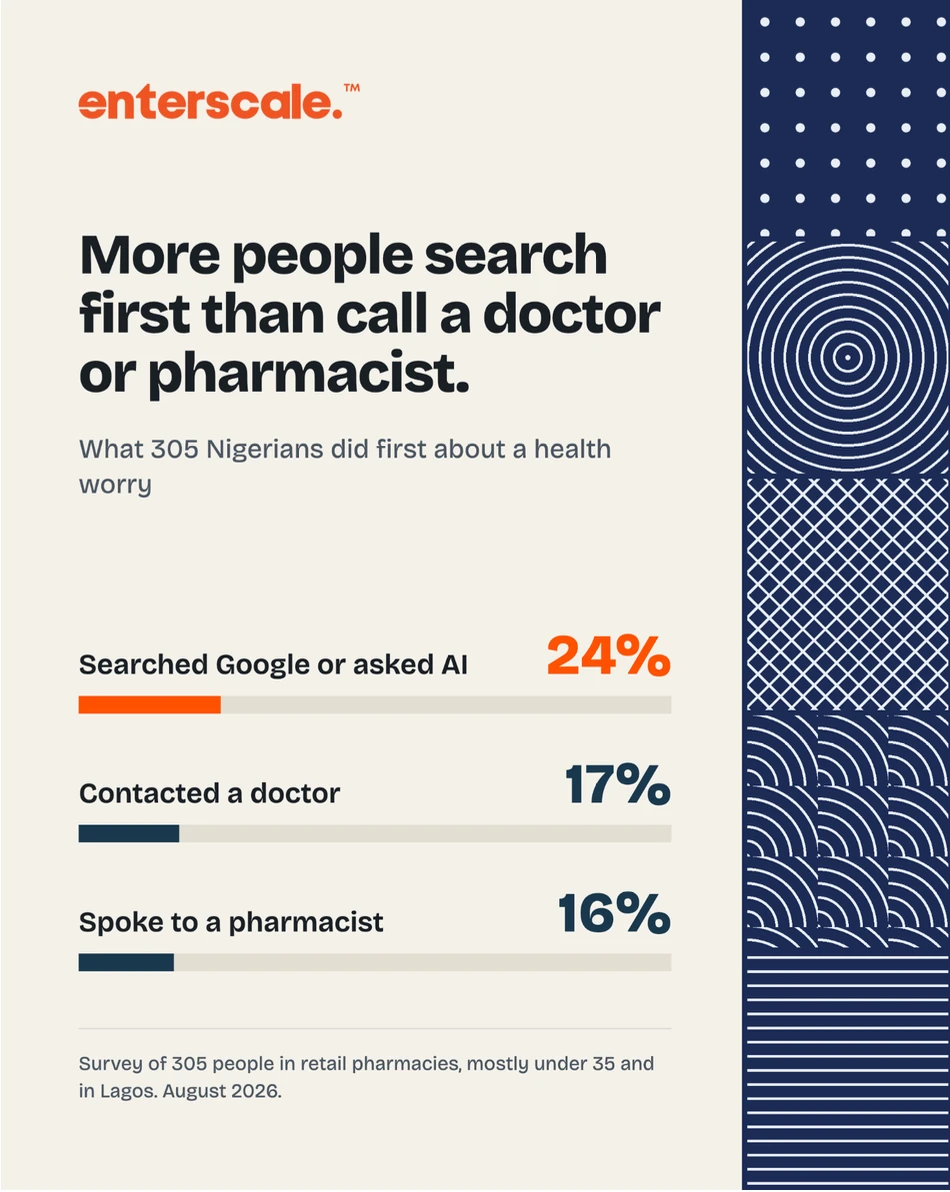
The short version: We asked in a pharmacy, with a pharmacist a few steps away, and more people reached for a search box first than for a doctor or a pharmacist. They weren’t after a pill. They wanted a quick, credible answer. Health brands in Nigeria need to be in that first conversation, and in it before the symptom shows up.
Recently, with Hexia Health, a new client in the health space, I walked in carrying an assumption I’d inherited from the 90s: that self-medication is “the villain” of Nigerian healthcare.
I came by it honestly. My dad was a pharmacist before he started a pharmaceutical marketing agency, and self-medication was the talking point of that era. I’ve also spent long stretches as a patient in at least seven Lagos hospitals, so I know the system (and the HMOs) from the patient’s side and I understand exactly why someone would skip the queue and buy the tablet. I just still filed it under “problem”.
My mum, a librarian and church minister, ruined me for leaving a question alone, so when Hexia asked us to find out what Nigerians actually do when something feels off, I went looking for the truth. It wasn’t where I’d left it.
Meet Hexia Health
Hexia Health is an online health provider that helps people work out what to do when something feels wrong.
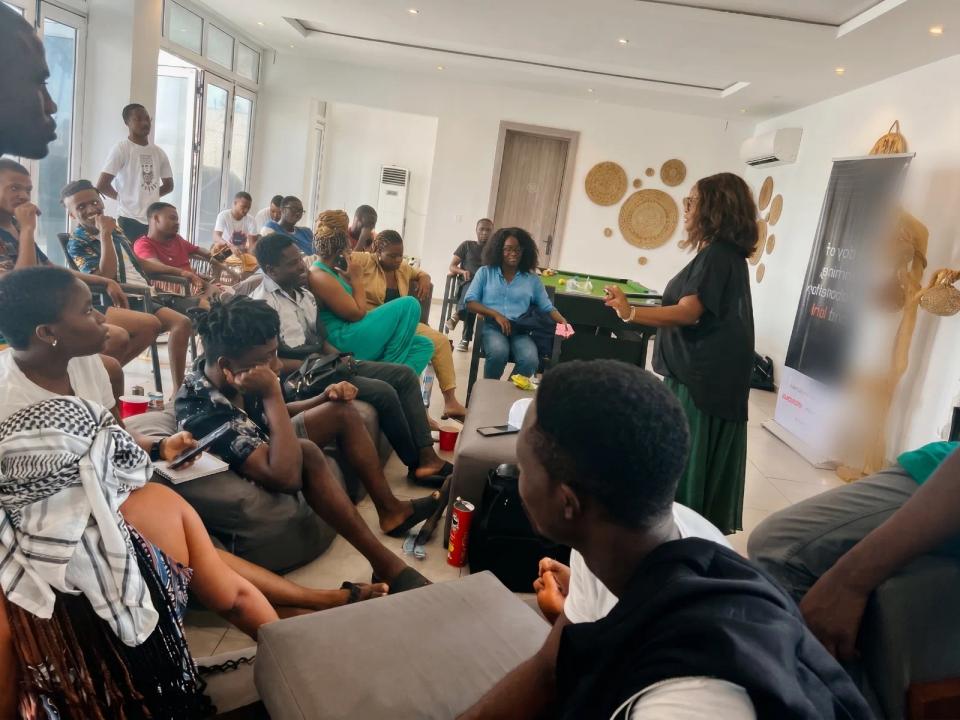
We wanted to hear from real customers. So we partnered with Mopheth pharmacies and ran a symptom-check study over three days in August 2026, across Victoria Island, Festac, and the Lekki environs. We ended up with 305 valid completions.
We didn’t recruit through an online panel. We met people at the pharmacy, which is about as close as you can get to the moment a health worry turns into an action.
A search came first more often than a doctor or a pharmacist
We asked what people did first when something felt wrong with their health. The most common answer was to search for it.
Read that again with the setting in mind. These people were standing in a pharmacy, the one place you’d expect the pharmacist to win, and a search box still got there first.
They aren’t looking for a pill
Around 60% told us they needed to understand what their symptoms meant and whether the issue was serious. When we asked what mattered most in getting help, 30.5% said getting it quickly, with trust close behind at 27.2%.
That is not the profile of someone hunting for a tablet. It is the profile of someone hunting for an answer, and for permission to stop worrying or to start worrying properly.
I want to be careful here. These numbers don’t prove self-medication has shrunk, and I won’t pretend they do. What they show is what people reach for first, and what they want when they get there. It has me rethinking whether self-medication is the villain I was raised to see, or whether it is a symptom of something else: people not being able to get a clear answer fast enough.
Nobody Googles a symptom they don’t have
This is the part I can’t stop mulling over. People tend to search once something already feels wrong. That works for a headache. It works badly for the conditions that don’t announce themselves.
Take hypertension. A nationwide survey published in Global Heart put age-standardised prevalence in Nigerian adults at 38.1%. A 2023 community screening in Lagos found awareness of the condition at just 34.7%. If the first conversation increasingly happens in a search box, it may start too late for exactly the conditions that go unnoticed.
Most of the effort in Nigerian health marketing still goes into physical distribution: the pharmacy counter and the clinic. Fair enough. But someone has to start the conversation before the symptom.
Five kinds of customer, wanting the same answers
When we analysed the 305 completions, five behavioural groups emerged. Here is who they are.
What 305 people can and can’t tell you
Treat this study as a direction rather than a national picture. It was 305 people, mostly under 35 and mostly in Lagos, all approached in pharmacies. It captures what people told us, and what people say and what they do are not always the same thing.
“But isn’t a search box just a worse doctor?”
Some will say that Google and ChatGPT are riskier than the pill, and they have a point. Search results vary in quality, and nobody should diagnose themselves from a chatbot.
But the answer isn’t to wish people back to the clinic queue. It is to make sure that a credible, doctor-reviewed answer is the one they find, and that a human is a visible step away. People still want that: 22% told us speaking to a healthcare professional was a priority. The searchers aren’t rejecting professionals. They are asking for a faster way to reach one.
Three questions for any health brand in Nigeria
People aren’t looking for a pill. They’re looking for someone to tell them what is going on, and more and more they ask the search box before they ask us.
To see what a fast, doctor-reviewed answer looks like, download Hexia Health or visit hexiahealth.co.uk and try it with a question of your own.
Run this for your category
If you build or sell in CPG, retail healthcare or pharma in Nigeria, we can run this kind of study for you. A few days in the places your customers decide, and a clear read on where their first conversation starts and who is already in it.
Bring the one question you are trying to answer. Book a call with Enterscale and we will tell you in thirty minutes whether a study like this would settle it.
Sources
- Prevalence, Awareness, Treatment and Control of Hypertension in Nigeria: Data from a Nationwide Survey 2017, Global Heart (2020)
- Hypertension prevalence, awareness, treatment and control in a 2023 community screening campaign in Lagos, BMC Public Health
- Hexia Health × Mopheth fieldwork, 21 to 23 August 2026 (305 valid completions)