Swoop has already done much of what I would have suggested a few months ago: ordering over WhatsApp (company-reported), a subscription called Swoop Ultra, ads covering more areas of Lagos, and partner combos. The moves are sound. The picture they add up to is not.
Last week I went through everything public on Swoop: Instagram, TikTok, the Meta Ad Library, both app stores, the website, the press, and Chowdeck’s pages for comparison. I wanted to see what a well-funded team does with $7.3 million. Everything below is public, plus the 2025 Mooyi survey of 431 Nigerians. I’ve kept what I saw apart from what I’m guessing.
- About ten active ads in the Meta Ad Library, all started in November, every one a price or an offer
- A fee breakdown shown before paying: ₦550 delivery and ₦168 service fee on a ₦2,400 order
- Around 340 Google Play reviews with repeated complaints about waits, order codes, support and payments, and iOS reviews calling the ads false
- 3,458 Instagram followers, 89 on TikTok, and a Google Form behind the bio link
- That customers won with a discount leave after one late order
- Whether Swoop’s WhatsApp ordering remembers customers or only shows a menu
- That most Lagos phones are Android, which makes a channel that works on any phone matter more
- How the economics add up, and whether UNILAG and Legends are basket-size tests
The promise is trust. The proof is a discount.
Swoop’s best idea isn’t a feature. Riders keep 100% of delivery fees, and the fee breakdown is shown before you pay. In a market where customers suspect every platform of padding the bill, and riders suspect the same, that is a real position.
Now look at where the brand spends its attention. The fairness story appears in a handful of posts and one press cycle. The ads are another matter. Here are seven of them.
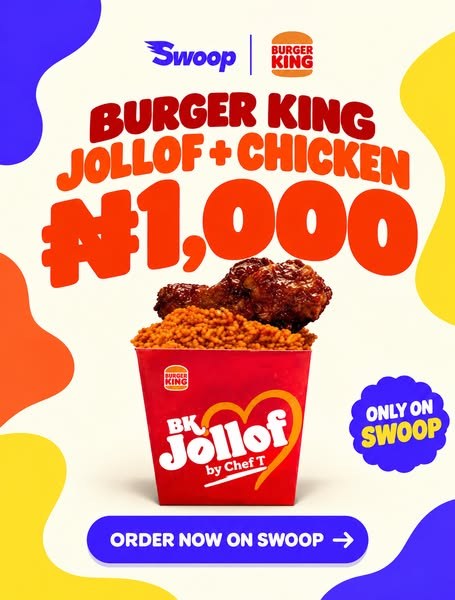
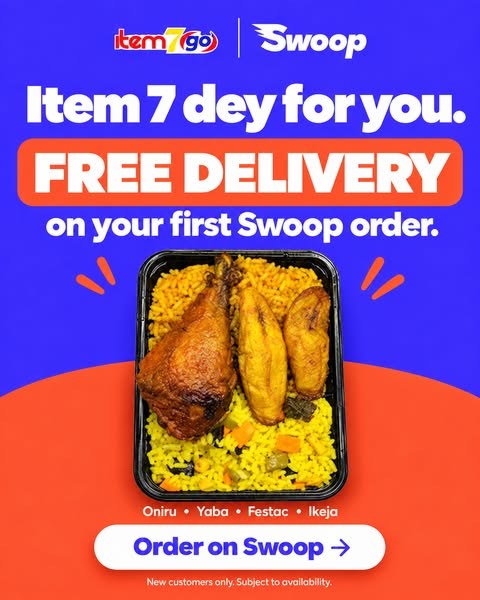

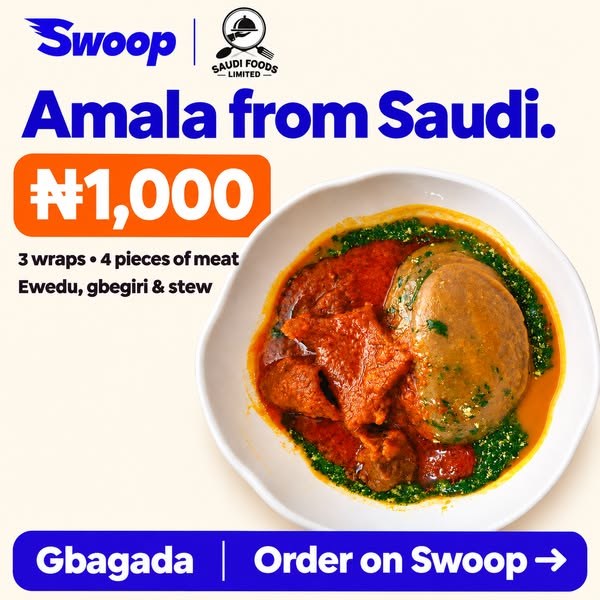
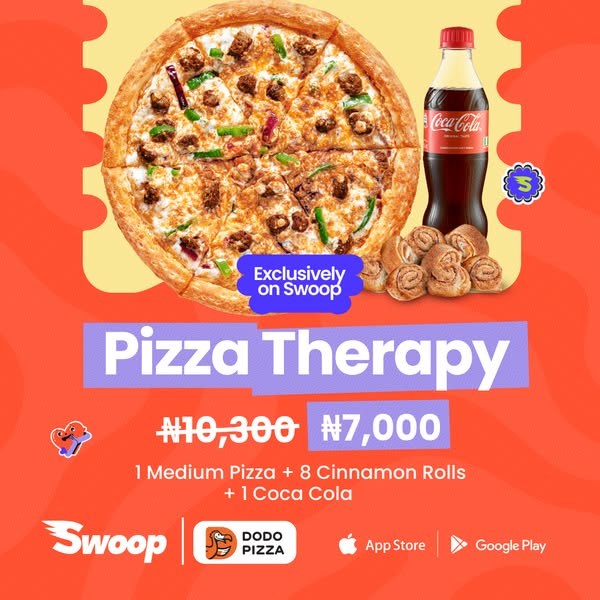
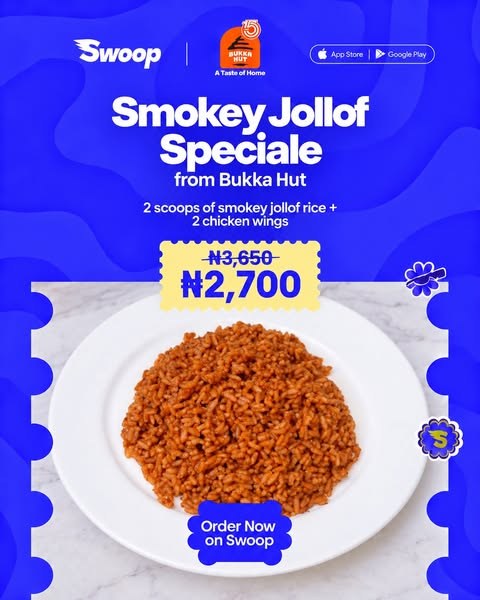

Seven of the ads I saw. Every one leads with a price or an offer, and six of the seven have an order button.
Then read the reviews. They are the unhappy sample, not the average experience, but they are what a prospect reads just before installing. Several iOS reviewers go further and call the ads themselves false, saying the deals they saw don’t exist.
The iOS items come from reviews sorted by most critical.
Here is what I take from it. A brand promise is a contract that operations writes and marketing only quotes. The delivery estimate in the app is your most-read ad, and when it says 35 minutes and the doorstep says three hours, that is the ad customers remember and repeat.
My survey points the same way: 52% said slow delivery would make them stop using a food delivery app, and speed edged discounts as a purchase driver. My guess: a ₦1,000 combo attracts people who come for the price. If their first order arrives late, they have no reason to stay, so Swoop has paid for the discount and still lost the customer.
Mooyi survey of 431 Nigerians, 2025.
Real food photos that show exactly what is for sale. One offer per ad, in big type, with a clear button on six of the seven. Three name the areas Swoop covers, and three carry app-store icons, which we like because they build trust.
The only message is price. None shows the delivery or the app in use, which is what Swoop actually sells, and none carries social proof beyond a star sticker. Six put the logo in the top third, which we advise against. Text runs close to the edge on a few, and in three the product name breaks across lines. The pizza ad has no order button.
A hungry person wants to know how soon. Lead with a delivery time Swoop can actually keep, ideally in a short video of an order going from tap to doorstep, and put the price second.
WhatsApp was the right enemy. Joining it is not beating it.
In my survey, 44% ordered through WhatsApp or Instagram, ahead of Glovo and Chowdeck. Swoop launched ordering on WhatsApp in August, according to its own press, so it read the same room.
Mooyi survey of 431 Nigerians, 2025.
What decides whether that matters is memory. WhatsApp wins because the restaurant already knows you. From the outside I can’t tell which of these Swoop has built:
The app has moved into someone else’s building and gained nothing.
It has taken what makes WhatsApp sticky and put reliability underneath it.
An illustration of the two possibilities, not Swoop’s actual flow. From the outside I can’t tell which one it is.
There is a second reason to care. Most phones in Lagos run Android, which I’d check against Swoop’s install split. If that holds, a channel that works on any phone matters even more. Joining a channel is cheap and absorbs nothing. What counts is whether the memory travels with the customer.
Owned reach is the cheapest growth Swoop isn’t collecting.
Swoop’s Instagram has 3,458 followers. Chowdeck’s has 39,900. On TikTok, Swoop has 89 followers and about nine videos.
Counts as seen on the public profiles, 18 to 24 November.
And yet one creator-style Reel reached 154,000 views and another 33,300, against 1,200 to 4,200 for most of the others. That is Swoop’s own audience telling it what works, twice. The link in the bio is a Google Form.
Counts as seen on the public profile, 18 to 24 November.
A spike is only growth if it has somewhere to land. A 154k Reel with a form behind it is attention walking into a room with no door.
Five changes I’d test first
Written for Swoop, but they work for any consumer product whose promise outruns its operations.
Quote the time you can meet. Compare the app’s delivery estimate with actual delivery times by area and by hour, then set the quote to one you meet on most orders. A shorter promise that holds beats a faster one that breaks. Test: the gap between quoted and actual time, week by week.
Earn the right to discount. Run price offers first where deliveries meet the quote, and pause them where they don’t. Treat every discount as a loan against future margin. Test: the share of discount-acquired customers who order again at full price within 14 days.
Show the receipt. Fees are already shown before you pay. Add what the rider earns on this order, so the fairness story is seen at the moment of purchase, not in a launch post. Test: checkout completion with and without the rider line.
Make WhatsApp remember. Let a returning customer reorder in one message, with the last order, notes and address already filled in. Test: repeat-order rate and time to reorder on WhatsApp versus the app.
Give every spike a destination. Replace the Google Form with a link that sends Android and iPhone users to the right store, plus the WhatsApp number. Re-cut the two winning Reels for TikTok. Test: installs and WhatsApp conversations from the link after the next Reel that spikes.
The economics are a question, and two quiet moves may be the answer.
Everything above assumes the economics can carry it, and that is the part I can’t see. The ₦168 service fee on a ₦2,400 order sits just under what a 7% fee on a ₦2,500 to ₦5,000 order would bring in (₦175 to ₦350). Swoop also gives riders 100% of delivery fees and, by press reports, charges restaurants less than Glovo (about 15%) and Chowdeck (about 10%). Chowdeck is reportedly profitable. I can’t tell how Swoop’s model adds up. I’m working from reported figures, not its books, so this is a question, not a verdict.
Two quieter moves may be basket-size experiments in disguise.
The UNILAG pilot
Swoop is one of two platforms approved for a three-month campus pilot. If it is run as a group-ordering test and not a download campaign, it tests the lever I would test first.
Swoop Legends
The merchant programme has four tiers and began with an eight-week pilot of five merchants. It gives merchants a reason to promote Swoop to their own customers, which costs less than buying that attention.
I’d like to see basket size reported next to order volume. I haven’t found a number yet.
What I’ll be watching
Do the delivery-time complaints fade?
Does Swoop ever report it next to order volume?
How does Chowdeck respond to a rival that is cheaper for restaurants?
The takeaway
I want Swoop to get this right. Lagos is big enough for operators who play the long game, and most of what I’ve described is a marketing problem with an operations answer, which is the least glamorous and most valuable kind.
If you run growth for a consumer product in Africa and any of this sounds like your own funnel, I do this for a living: market entry, positioning, growth strategy and channel execution. I’m happy to run the same kind of audit on your product. Start at enterscale.com or DM me.
Where this started: a first draft from May
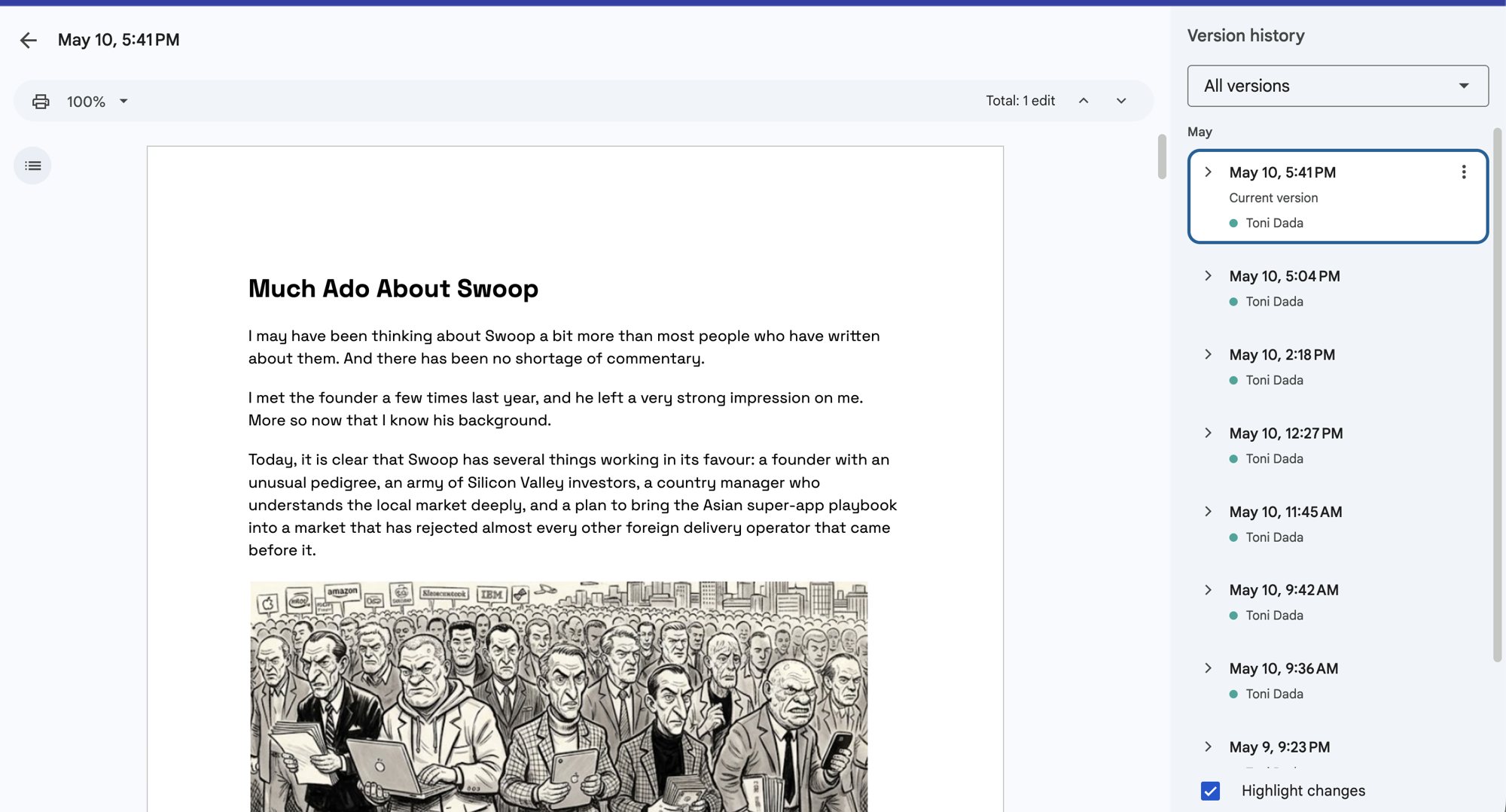
Tap either screenshot to open it full size.
Sources and further reading
- Afridigest, “The Speculator’s Son: Inside Swoop’s Bet”
- Foodpod by Osarumen Osamuyi, “#1: Magic Beans”
- TechCabal, “Swoop raises $7.3 million seed for African super app, food delivery first”
- Swoop’s Instagram, TikTok, website, Meta Ad Library (Nigeria) and Apple App Store and Google Play listings, viewed 18 to 24 November 2026
- Chowdeck’s Instagram and app-store listing, viewed November 2026
- Techpoint’s coverage of Swoop’s WhatsApp ordering (company-reported)