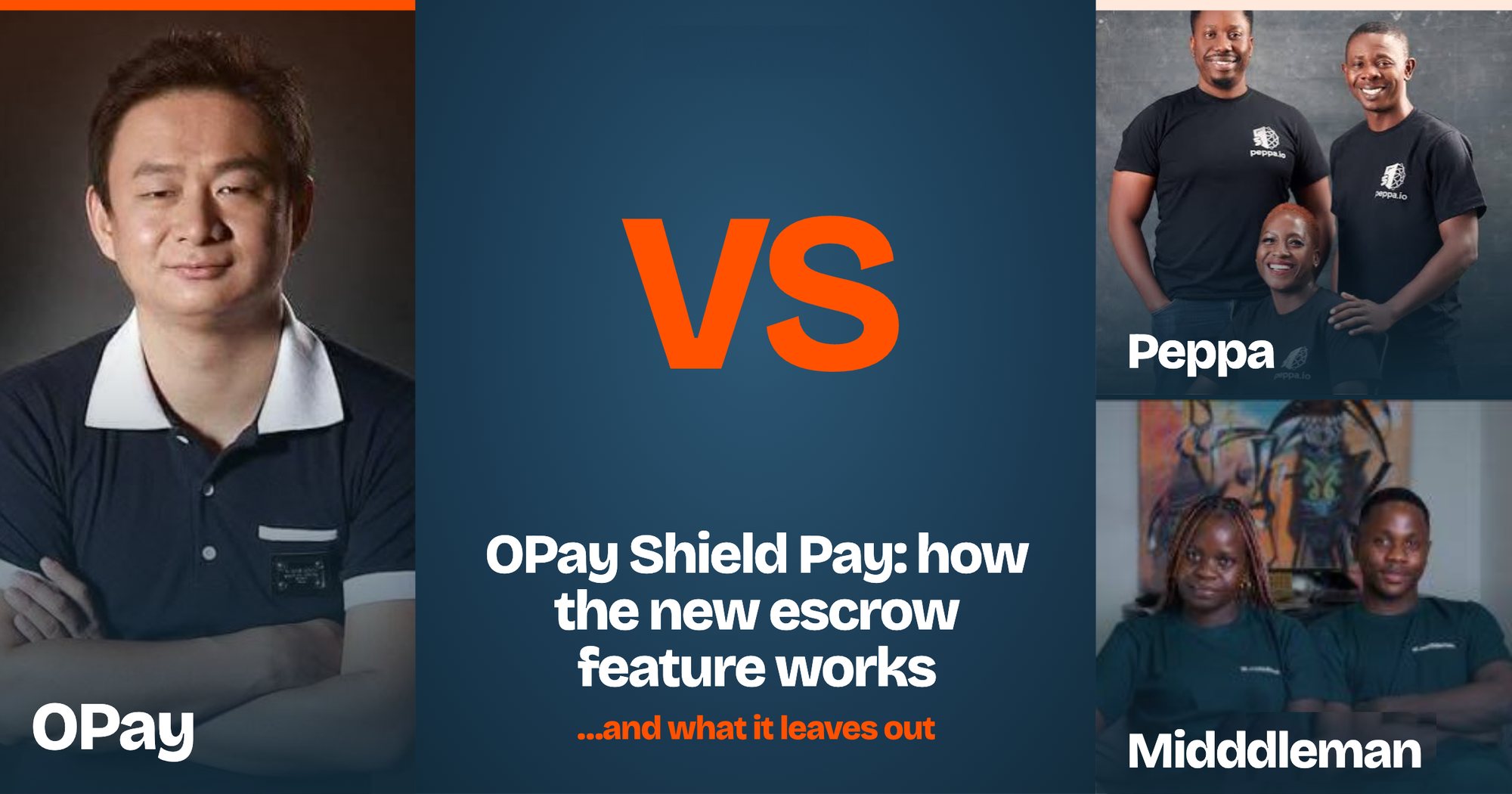
Escrow is not a new idea in Nigeria. Startups have been trying to sell it to us for years. What is new is who just shipped it: a company that Nairametrics put at more than 60 million users last October, and which therefore already owns the two things every escrow startup before it had to buy. One is a place on the customer’s phone. The other is a reason to trust whoever is holding the money.
What Shield Pay actually does
Shield Pay lives inside the OPay app and covers one deal at a time. Going by the launch coverage, the flow runs like this:
Both people need OPay accounts. The buyer finds the vendor by phone number or OPay account details and can check the vendor’s trust level and reviews.
They agree the amount, what is being delivered and by when, and the seller sends a payment request.
The buyer has 24 hours to pay. OPay holds the money instead of passing it on.
The seller submits evidence of delivery. The buyer has seven days to review it, and can extend that once by another seven.
When the buyer confirms, OPay releases the funds. If something is wrong, the buyer can raise a dispute even up to 15 days after confirming. Both sides then have 48 hours to submit evidence, and OPay decides.
The flow as described in the launch coverage. An illustration, not OPay’s own screens.
Three things are worth flagging. Access is by invitation, with OPay inviting users from mid-November. The coverage I read gives no fee rate or amount limits, only that sellers can withdraw released funds to an OPay wallet with no extra release fee. And because both sides need OPay accounts, a buyer who banks elsewhere cannot use it with an OPay seller.
OPay’s own promo video, posted on 18 November, tells a simpler story than the press coverage. The customer pays through Shield Pay, OPay holds the funds while the order is fulfilled, and the vendor can see the payment is secured before sending the goods. The customer inspects the item and taps to confirm, and the money lands in the vendor’s wallet instantly. It says vendors have a credit score that helps customers judge them, and it invites people to join a waitlist. The narration doesn’t mention disputes, review windows, fees or limits, but the app screens it shows carry a service fee line tagged “Limited-time free”, and the small print says the feature is only for transactions where both sides have OPay accounts, and that OPay handles payment disputes only, with order fulfilment left to the seller. I didn’t spot a fee rate or cap on screen. The whole film is a single payment for goods that arrive, which is where my point about instalment trades comes from.
Why Nigeria needed this
Most social commerce here runs on direct bank transfers, and a transfer has no undo button. You see something on Instagram, the price looks right, you send the money, and then the seller stops replying. TechCabal describes a cost that doesn’t stay with buyers: sellers raise their prices to cover losses, and buyers walk away from good deals.
Escrow founders have been pointing at this for years. Vahlid’s CEO said a poll of people the team knew directly found 44 to 48% had been scammed. That is a small founder-run poll, so I’d read it as a signal and not a statistic. A recent Nairametrics piece, which is brand content for EscrowPay, adds that traditional escrow was built for property and large contracts, not the everyday ₦20,000 deal between an Instagram vendor and a customer.
of the people Vahlid’s team knew directly said they had been scammed.
A small, founder-run poll. Read it as a signal, not a statistic.My view is that the real cost in this market is trust, and escrow is a way of lowering it. What changes with OPay is not the mechanism. It is that protected payment can become the default for people who never went looking for it.
A feature, a company, and the startups that already learned the lesson
The most instructive story I found is Midddleman, which is spelled with three d’s. Founders Omolara Sanni and Adeola Owosho launched an escrow platform around 2023, drawing on years of selling on Instagram themselves. In TechCabal’s account, it worked technically but the market wasn’t ready. Users didn’t trust the vendors, or the platform, to hold their money, and Sanni said they would have needed brand equity they couldn’t afford. They rebuilt Midddleman as a payments and procurement platform for Nigerian businesses importing from China, which TechCabal says handled close to ₦2 billion in 2025 on $46,000 of funding. (TechCabal’s dates for the escrow launch and the pivot don’t line up, so treat the sequence as approximate.)
Today the escrow story has all but disappeared from how Midddleman presents itself. Its website is titled “Source Goods From China Reliably and Confidently”, and its App Store listing calls it a companion app for African SMEs exploring imports from China, with purchasing, payment and logistics happening outside the app.
The idea wasn’t wrong. The right to hold the money was the thing they lacked. OPay has it already, and that is exactly the advantage Shield Pay starts with.
Peppa, which Banky Alao co-founded with Bridget Yadua-Soremekun and Emmanuel Obute, is a second case. TechCabal reports that the idea came after Alao lost $7,000 paying for a car online in 2021. Peppa held the buyer’s money in a “safe deposit” until the buyer confirmed the item, took a 1 to 2.5% commission from buyers, and charged sellers a subscription. Disrupt Africa puts it in the ARM Labs Lagos Techstars Accelerator, raising a pre-seed round at the time. Early on it had about 1,000 sellers and had signed a partnership to plug into First Bank’s mobile money service.
That last detail is the one I keep coming back to. Peppa’s route to distribution was to borrow someone else’s app and someone else’s trust. OPay doesn’t need to borrow either, because it is the app and it holds the money. Peppa has also moved on from consumer escrow. Today its LinkedIn page describes “Peppasync”, a working-capital tool for UK build-to-order manufacturers, and Alao’s own profile now reads the same way.
Where Peppa ended up is a business built around deposits paid up front for custom work that takes weeks. This suggests the money gap between paying and receiving is a real pain in this kind of trade, and that it shows up on both sides of the deal.
Other escrow players face the same arithmetic. EscrowPay went live in June on WhatsApp, with a licensed bank holding the funds and NIN verification for users, and charges sellers 1.75% and buyers a 2.3% processing fee. Each had to persuade two strangers to sign up before it could protect either of them.
What happened to the escrow startups

Midddleman
StartedAn escrow platform, around 2023.
NowPayments and procurement for imports from China. Close to ₦2 billion handled in 2025 on $46,000 of funding.

Peppa
StartedA “safe deposit” for buyers. 1 to 2.5% from buyers, a subscription from sellers.
NowPeppasync, a working-capital tool for UK build-to-order manufacturers.
EscrowPay
StartedLive in June on WhatsApp. A licensed bank holds the funds and users are NIN-verified.
NowStill escrow. Sellers pay 1.75%, buyers a 2.3% processing fee.
So is Shield Pay a startup killer? For a product that is essentially “escrow for vendors” inside the OPay universe, I think yes. For everyone else I think it opens more room than it closes, for two reasons.
It is a walled garden. Both people need OPay accounts. A Nigerian seller’s customers bank everywhere, and asking a buyer to open an OPay account first costs some sales. My view is that escrow should be bank agnostic. Its value comes from being neutral between two strangers, so it shouldn’t depend on which bank each of them picked. That neutral layer is the gap I’d build in.
Both sides need OPay accounts, so a buyer who banks elsewhere cannot use Shield Pay with an OPay seller.
The walled garden matters more as the deal gets bigger. Buying a dress from Ghana or a car from Kenya is where trust is thinnest and the sum is largest, and the person on the other end will not be on OPay. The larger, staged, cross-border deal is where neutral escrow looks most needed, and it is the corner Midddleman moved into.
Depth beats breadth in the verticals. The coverage describes a single release when the buyer confirms. I didn’t see staged payouts, which is what freelancers and service providers need, and cross-border deals are on EscrowPay’s roadmap. Those are narrower problems than “protect any online payment”, and a general feature rarely goes deep on them first.
There is one more thing I’d watch. OPay holds the money and also decides disputes by reviewing the evidence. That works fine at ₦20,000. My guess is that the first contested ₦500,000 deal will show whether people see the holder as a neutral party.
Where escrow still has room: trades paid in instalments
There is a kind of deal Shield Pay, as the coverage describes it, doesn’t seem built for. It is the trade where the customer pays in instalments and is often disappointed at the end. Think of a furniture maker building a sofa set. The customer pays a deposit so the work can start, pays more as it goes, and collects the finished piece weeks later. Both sides can lose: the customer pays most of the money before seeing the result, or the maker buys fabric and timber and the customer disappears.
That is milestone escrow, where money is released in agreed stages. The idea already exists: Vahlid offers milestone payments for freelance work, and EscrowPay lists milestone escrow on its roadmap. Shield Pay’s windows, 24 hours to pay and seven days to review, look sized for goods that arrive within days, not a sofa that takes weeks. That is my reading of press coverage, not a confirmed limitation.
Before any money moves, they agree what right looks like: a sketch, measurements, photos and milestone dates. The escrow holds the money.
The first part is released so work can start and the maker can buy fabric and timber.
Fitting photos show the agreed stage has been met, so the next part is released.
The customer collects the finished piece, confirms it matches what was agreed, and the last part is released.
An illustration of milestone escrow, not a specific product. Shield Pay’s lack of staging is my reading of the press coverage, not a confirmed limitation.
I think this fits better than it first looks, for three reasons. The pain is repeated and public, in the photo of what I ordered against what I got. Both sides have a reason to want it, because makers get a committed deposit and customers get protection. And the evidence is naturally visual: fabric, measurements and fitting photos.
The hard part is that disputes in these trades are subjective. “It doesn’t look right” is difficult to adjudicate unless the parties agreed on what right looks like at the start, with a sketch, measurements, photos and milestone dates.
What I would take from it
If your product is a feature, assume a platform will ship it. The test is whether your customer’s existing app could add what you do within a quarter. If the answer is yes, your moat has to be something the platform can’t copy, such as neutrality, a vertical, or a relationship.
Trust is distribution. Midddleman’s escrow worked and still stalled, because people didn’t trust a new name with their money. Who holds the money matters as much as how the mechanism works, so earn that right before you scale the product.
What I’ll be watching
Fees and limits
The promo video shows a service fee line marked “Limited-time free”, which suggests a charge once the promotion ends. I haven’t found a rate or a cap. Either would change who this suits.
How the startups respond
Do they go bank agnostic, go vertical, or fold the product into something larger, as Midddleman did?
If you are building in payments or commerce in Nigeria and want a second pair of eyes on where your product sits against a platform that can ship your feature, I do this for a living. Start at enterscale.com or DM me.
Sources
- Digital Economy, “OPay launches Shield Pay”
- TechCrier, “What is OPay Shield Pay”
- Paylo, “OPay Shield Pay and escrow in Nigeria” (brand blog, Paylo sells escrow)
- TechCabal, “How two Nigerian graduates built a ₦2 billion trade machine”
- TechCabal, “Why Nigerians keep getting scammed buying online, and how escrow fixes it” (EscrowPay)
- Nairametrics, “The trust problem killing Nigerian ecommerce” (EscrowPay brand content)
- Nairametrics, interview with Vahlid’s CEO
- Nairametrics, “OPay’s approach to secure payments”
- Midddleman on the App Store
- WeeTracker, “Lagos Angel Network invests in Midddleman”
- Techpoint, on Vahlid’s milestone payments
- Peppa (Peppasync) on LinkedIn, About page, read 24 November 2026
- TechCabal, on Peppa and Bankole Alao (undated, 2023)
- Disrupt Africa, “How Nigeria’s Peppa makes it safer to shop socially online”
- OPay Nigeria, “Introducing Shield Pay by OPay” (promo video, 18 November 2026)